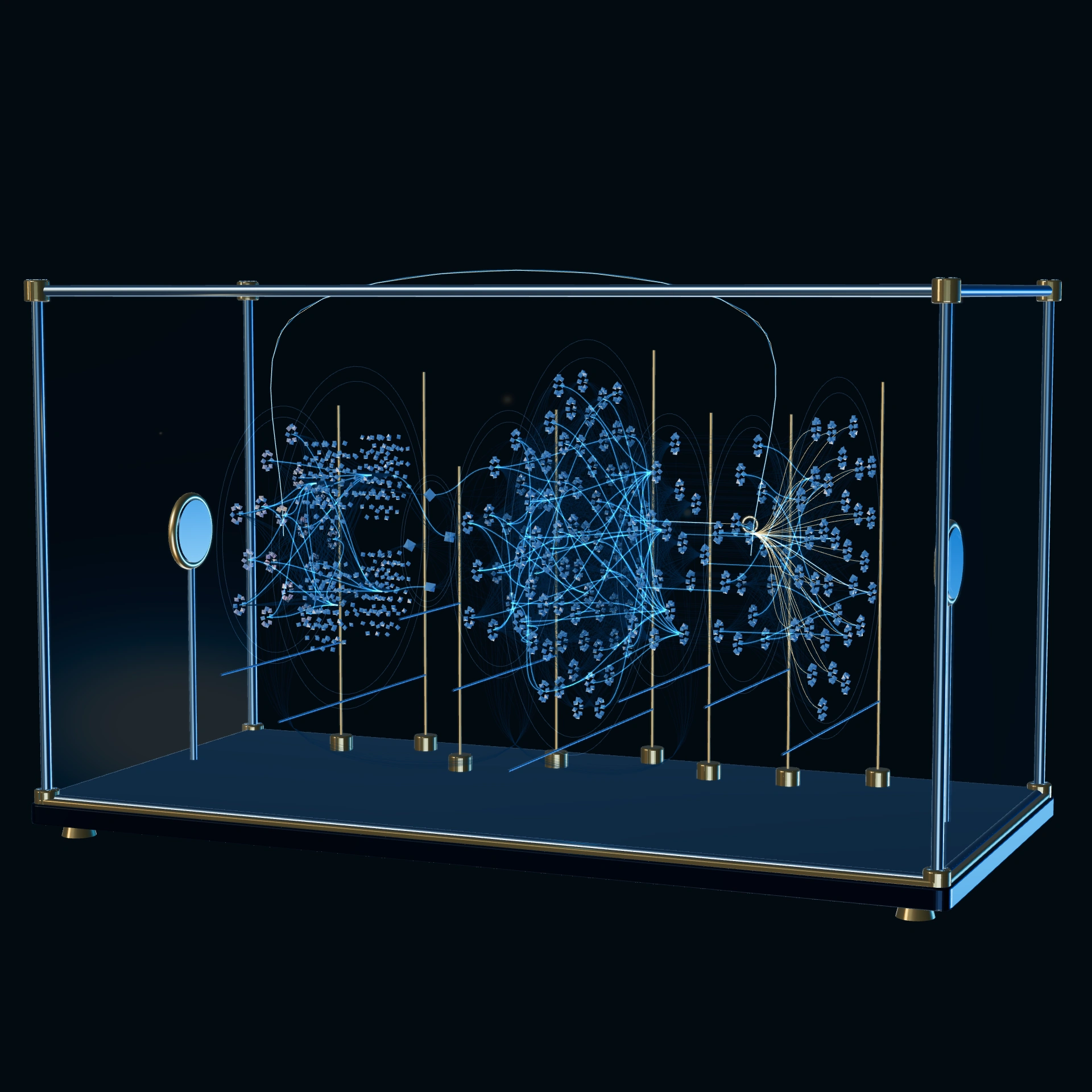
Start the network to follow a scripted signal. Play replays it; Pause holds a frame. Drag the viewer to orbit; Settings opens coordinate inspection and camera controls.
TYLER J.H.G.RESEARCH / SYSTEMS / MLPUBLIC NODE
Agent infrastructure · machine learning · research systems
Buildingstrange thingscarefully.
I’m Tyler Harbin-Giuntoli, a software engineer at Microsoft. I build agents that can recover from failed tools and keep working, and machine-learning experiments that make the mechanism visible. I’m interested in what a system can do, what gets in its way, and how we measure the difference.
The background replays a recorded generation from the same trained research language model used in the articles. Its colors follow real intermediate tensors across three passes through the shared block.
A representation is useful only if the next operation can use it. Start with the connections: the wide state narrows through attention, expands through the feed-forward block, then returns to the shared state.
128-wide state · 4 attention heads · one block, three passes
Inspect the architecture
This background renders recorded model tensors at native display resolution using WebGPU or WebGL2, with a video fallback. Playback is retimed; visual brightness and point sizes smoothly transition between recorded observations and are normalized per layer. It performs no live inference on the homepage. Architecture and aggregation map · Trained model identity.
Current result: The model had learned a useful distinction that its own prediction layer barely knew how to use. On the frozen revision-branch benchmark, a small external readout recovers that distinction; the next test changes the consumer and asks whether the recovered signal improves next-byte prediction.Read the result →
A useful representation and a useful prediction are different claims. The research follows that gap: what the state retains, what the consumer can recover, and what changes when we replace the operation between them.
What does a compact state retain, and which operations let the model use it? I test those questions with frozen-model comparisons and recurrent-state diagnostics.
Local inference across devices with different compute and memory limits. The scheduling has to account for where the model, context, and available capacity actually reside.
I build production systems and independent research with the same habit: attack assumptions, measure failure, and keep working until the mechanism is clear.